Step 1 — Origin
The land & the farmer
Volcanic soils, altitude, and smallholders who treat coffee as legacy. Every season is a negotiation with weather and hope—and we show up beside them, not above them.
Our story
This is how YEET COFFEE moves from a dream in Kigali to the world’s finest cups—through people, patience, and a process you can follow from cherry to export.
Who we are
In 2021, YEET COFFEE started where stories often end: at the cup. We opened in Kigali because we believed Rwandan Arabica deserved a stage equal to its quality—a place buzzing with ambition that matched the bean. We were a proof of concept: if we could honor the brew, we could one day honor the origin.
That belief pulled us backward—toward the farms, the washing stations, and the hands that sort cherry by cherry when the world isn’t watching. Today we are fully integrated: we manage our own stations and direct sourcing so the same spirit—speed, quality, bold care—shows up in every 60kg burlap bag we ship.
At our core are the women who make Rwandan coffee possible—meticulous sorting at the stations, careful tending in the fields. Sixty percent of our workforce across stations and plantations are women, in leadership and fair-wage roles. When you invest in them, you invest in households, children, and communities—not in a faceless commodity.
We speak of Nyabumera, Karongi mist, and farmers who refuse to settle for “good enough.”
From cherry to export
Scroll on mobile or read down the line on desktop. Each step is where quality is won or lost; we choose to slow down where it matters.
Swipe
Step 1 — Origin
Volcanic soils, altitude, and smallholders who treat coffee as legacy. Every season is a negotiation with weather and hope—and we show up beside them, not above them.
Step 2 — Partnership
Sourcing for 85+ isn’t elitism—it’s a lever. We start with selective picking so only red ripe cherries are harvested, then build quality from the farm upward. Higher scores open the premiums that lift households when we refuse to treat coffee like a faceless commodity.
Step 3 — Intake
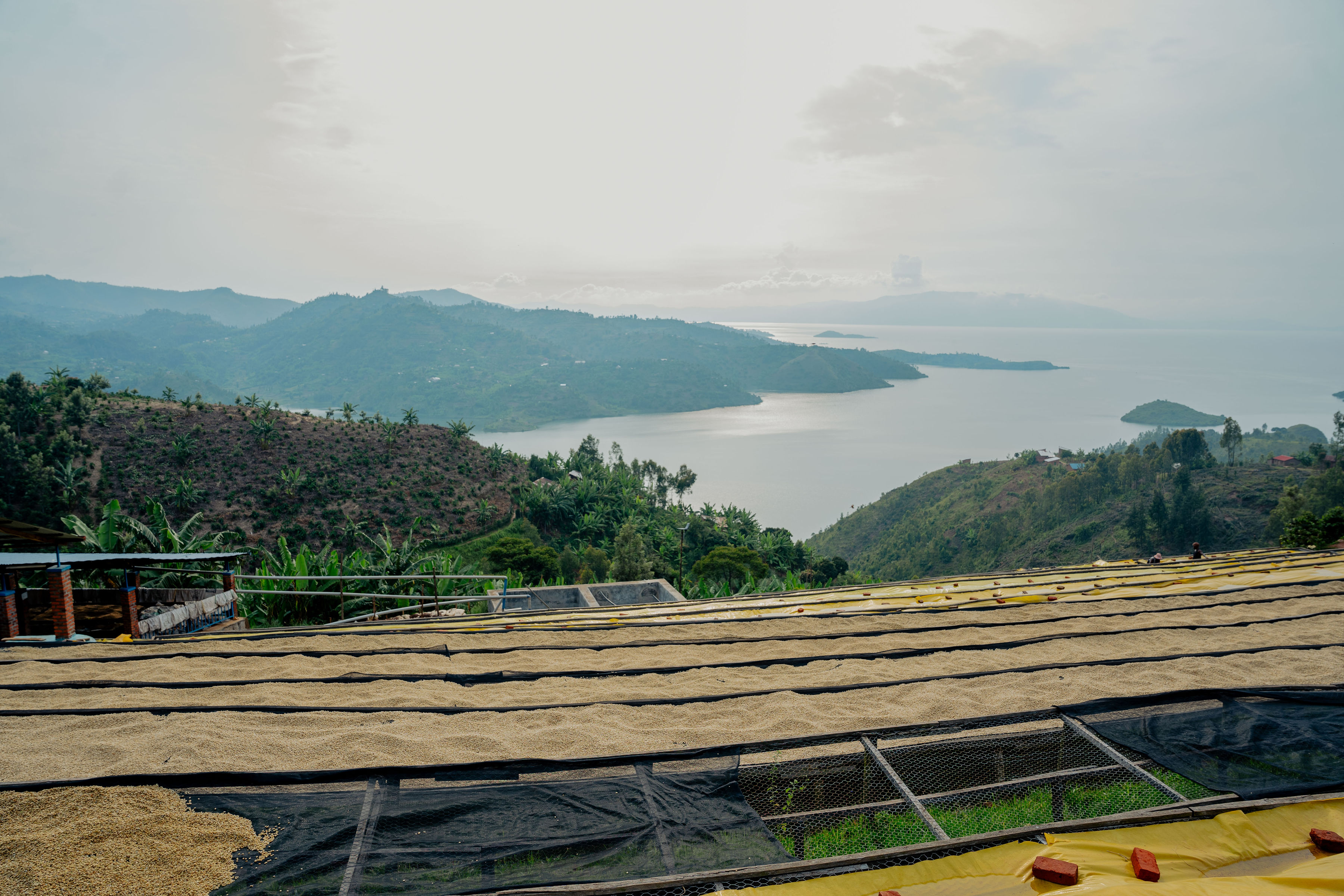
At Nyabumera and Kigarama, Lake Kivu tempers the day—slow ripening, complex sugars. Cherries arrive to be weighed, known, and cared for as individual lots.
Step 4 — Processing
Fully washed and honey protocols with spring water and obsessive sorting. This is where “clean” and “intense” stop being opposites—when discipline meets terroir.
Step 5 — Drying
Sun and turning and vigilance—no shortcuts. The drying yard is where patience becomes flavor you can taste in a roastery thousands of miles away.
Step 6 — Quality
Our roots in Kigali remain co-pilots: cupping, calibration, honesty—with NAEB as a witness to the cupping results we share with buyers. The farmer’s sweat deserves a final judge who won’t flatter a flawed lot to make a sale.
Step 7 — Export
Green coffee leaves Rwanda as a story you can retell—who grew it, how it was processed, and why it matters. That is the YEET standard.
Bean quality
We work only in premium specialty Arabica, targeting lots that cup 85 and above. That line in the sand protects farmers too: it is where market premiums start to mean something beyond words.
Taste begins underground—volcanic soils, mineral drainage, Bourbon variety nurtured by lake-cooled nights in Karongi. At Nyabumera, slow maturation beside Lake Kivu builds sugars and acid that sparkle. At Kigarama, recognized by NAEB for some of Rwanda’s highest-scoring beans, consistency in the 86+ range reflects women-led selection and drying that specialty buyers in Europe and Asia rightly expect.
When you brew our coffee, you should taste place, patience, and pride—nothing anonymous.
Our impact
Our mission is to pull coffee out of its commodity past. We measure success in how far impact scales—for farmers, for our stations, and for the bridge we keep building to the cup.
Pillar 1
Partners, not transactions. Moving smallholders up the value chain so specialty premiums show up where bills are paid and children go to school.
Pillar 2
Two hearts of the operation—where science meets tradition and where excellence is negotiated one hour, one batch, one bed at a time.
Pillar 3
Where proof happens daily—connecting the farmer’s labor to what a stranger tastes when the cup finally finds them.
The power of 60%
Women perform the most exacting work in our chain—and they lead it. Sixty percent of our workforce at stations and on plantations are women. That is not a statistic we tuck away; it is how we define excellence.
Walk our stations and numbers on the homepage, or reach out when you are ready to taste the journey yourself.
← Back to home